We speak to more than 100 South African businesses every month about their website needs.
And the pattern is obvious.
Most businesses are not getting websites because it is trendy. They are getting websites because not having one is costing them money.
In 2026, a website is no longer a nice-to-have brochure. It is your credibility asset, your sales tool, your customer acquisition channel, and increasingly, the source of truth that search engines and AI tools use to understand your business.
Here are the 5 biggest reasons South African businesses are choosing to get websites in 2026.
01 — DIY websites are making businesses look less credible
A lot of business owners start with the same idea:
"I will save money and build it myself."
At first, that sounds smart. In practice, it often becomes expensive.
Because most business owners are not designers, copywriters, SEO specialists, or developers. So they spend hours trying to piece together a site that "works," but still ends up looking unpolished, loading slowly, and failing to convert visitors into customers.
And that creates a bigger problem than most people realize.
A weak website does not just sit there. It actively damages trust. When a potential customer lands on a sloppy site, they assume the business behind it is sloppy too. If they were already unsure, that website pushes them away instead of closing the sale.
The real cost of a DIY website is usually this:
- Lost trust from potential customers
- Time wasted trying to fix things outside your expertise
- Ongoing hosting and domain costs for a site that brings in no leads
- Having to hire a professional anyway after months of frustration
A real example: Bettalyfe
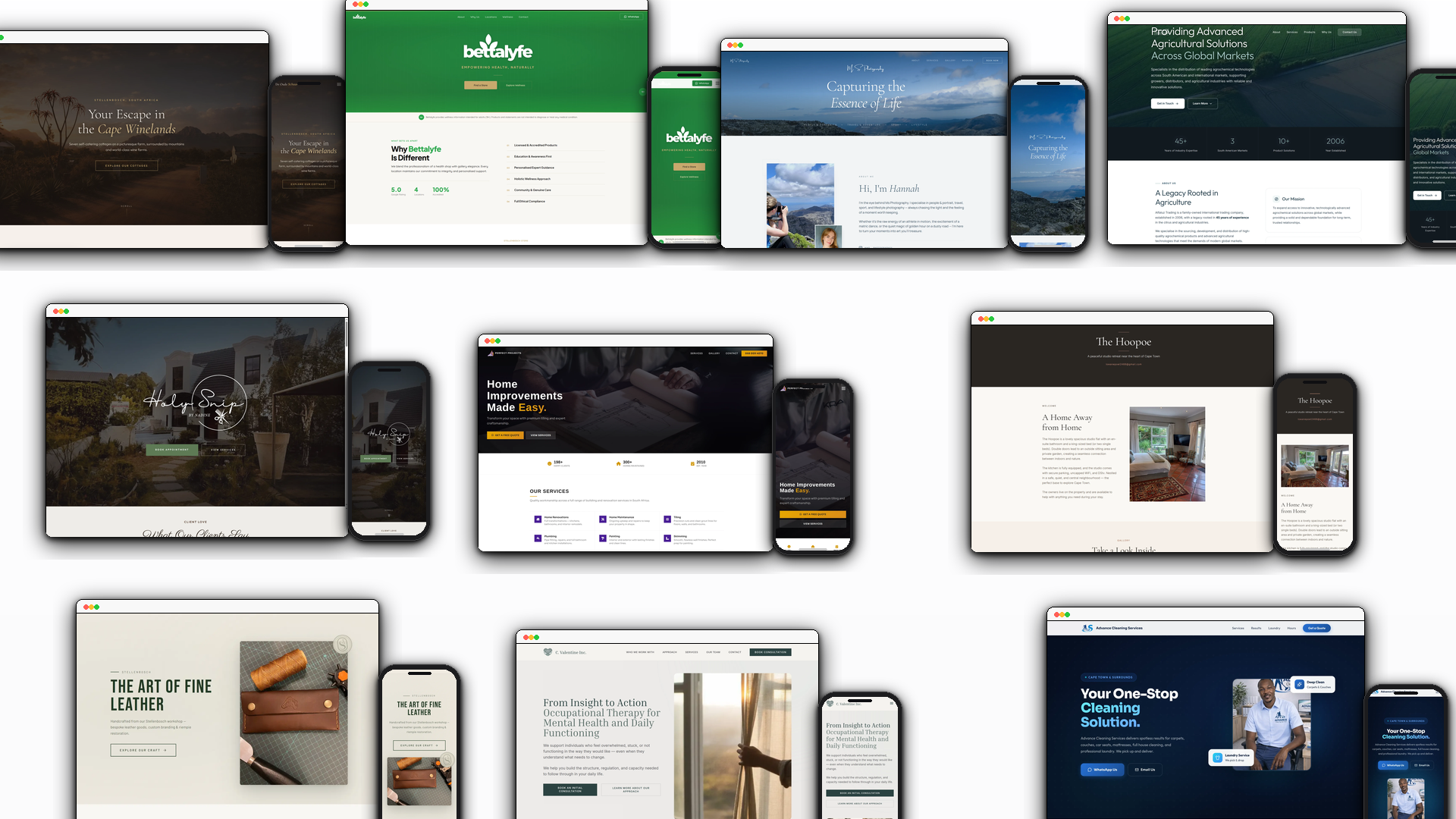
Jo, the owner of Bettalyfe, came to us after reaching the end of her patience.
She had built her own site for her health and wellness business, which already had a loyal customer base, multiple physical locations, and strong Google reviews. But despite all that, her website was not showing up when people searched for the products and services she offered in the areas she served.
And the few people who did find the site were not having a good experience.
It was slow. It was not built for mobile-first browsing. In a market like South Africa, where mobile traffic dominates, that is a serious problem.
So even though the business itself was strong, the website was invisible to Google and unimpressive to visitors.
We rebuilt the site with a mobile-first structure, clear messaging, and proper SEO foundations.
The result?
Her website started supporting the reputation she had already built offline. Combined with her existing Google reviews, the new site helped her climb local search rankings and attract a new wave of customers.
That is the difference between "having a website" and having a website that actually works.
02 — Businesses want a new source of customers
This is one of the biggest drivers by far.
South African businesses want more customers, and they know relying only on social media is risky.
Social media is useful for attention. A website is what helps turn attention into action.
When someone is searching on Google for a service, product, or solution, they are usually much closer to buying than someone casually scrolling Instagram or TikTok. That is why websites do the heavy lifting at the bottom of the funnel.
They help businesses capture demand that already exists.
Google still matters. But AI search matters too.
More business owners are also starting to think ahead.
They can see that customers are not only searching on Google anymore. They are also asking questions in tools like ChatGPT and Gemini.
That changes the game.
If your business has no real website, no structured content, no clear service pages, and no useful explanations of what you do, you are much harder to discover in both traditional search and AI-assisted search.
A good website helps your business by:
- Giving search engines clear content to index
- Giving AI systems better public information about your services
- Letting you control the narrative around your business
- Increasing the chances that your company is surfaced when people ask for recommendations
If you want to be found, you need a place online that you own. That place is your website.
03 — Businesses want to save time and reduce repetitive queries
A surprising number of businesses are still handling customer acquisition in a messy way.
They are juggling WhatsApp, email, Instagram DMs, Facebook messages, phone calls, and manual follow-ups. Prospects are at different stages. The same questions get asked again and again. Sales teams waste time repeating information that should already be easy to find.
This is where a good website becomes a force multiplier.
The best websites do not just "look professional." They reduce friction in the sales process.
They answer questions before someone asks them.
They move customers forward before a salesperson gets involved.
What businesses want their websites to do
The businesses we speak to are increasingly using websites to handle the most common barriers to purchase, including:
- Building trust with testimonials and case studies
- Explaining products and services clearly
- Answering FAQs that sales teams hear every day
- Displaying pricing, packages, or starting costs
- Clarifying terms and conditions upfront
- Guiding customers toward the next step
When this is done well, the website becomes part of the sales process.
It does not replace your team. It makes your team more efficient.
And in many cases, businesses also want to go one step further:
They want customers to buy directly through the site.
That means moving away from fragmented manual processes and creating a more standardized, scalable way to sell online.
For many South African businesses, that includes shifting from back-and-forth EFT-based workflows toward smoother digital purchasing experiences.
04 — Businesses want analytics so they can see what is working
You cannot improve what you cannot measure.
That is why businesses that are serious about growth are investing in websites with proper analytics from day one.
Usually, these are businesses that either want to start running paid ads or are already spending money on ads and need better visibility into what happens after the click.
They want to know:
- Where visitors are coming from
- Which campaigns are driving results
- What pages people spend time on
- Where users drop off
- What content leads to enquiries or purchases
The 4 most common tools we see businesses asking for
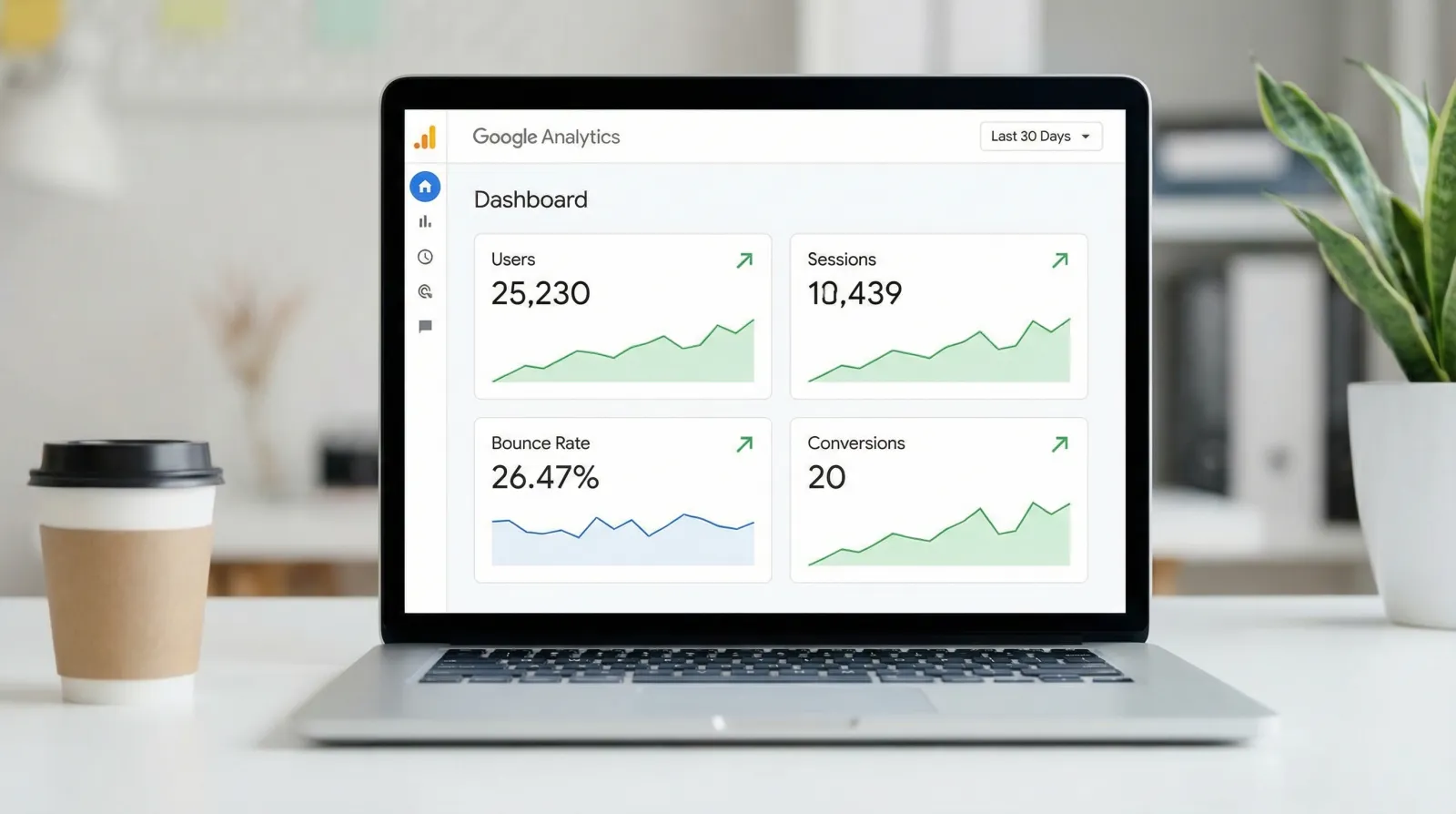
Google Analytics
Helps businesses understand traffic patterns, user behaviour, acquisition sources, device usage, and page performance. It is the baseline for understanding how people use your site.
Meta Pixel
Tracks the impact of paid campaigns across Facebook and Instagram. Especially useful for B2C businesses that want to measure conversions, build retargeting audiences, and improve ad performance.
LinkedIn Insight Tag
Helps B2B businesses understand how LinkedIn visitors behave after clicking through to their website. Useful for measuring campaign effectiveness, retargeting professional audiences, and optimizing lead generation.
Microsoft Clarity
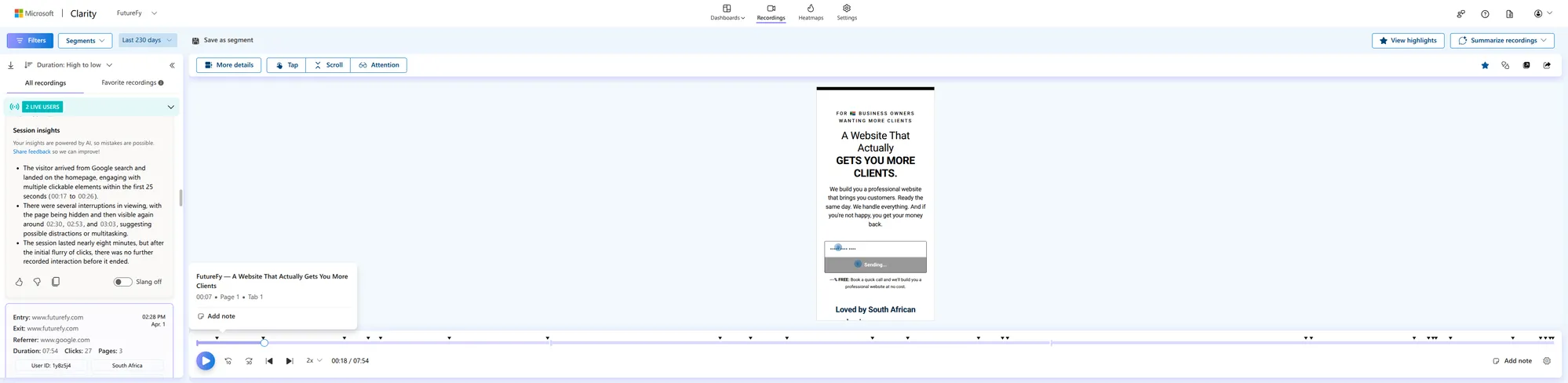
Gives businesses visual insight into how users actually interact with a site. Heatmaps and session recordings reveal what visitors are clicking, what they ignore, and where confusion is happening.
This is the shift:
Businesses are no longer satisfied with just having a website. They want a website that gives them data.
Because data leads to better decisions. Better decisions lead to better marketing. Better marketing leads to more revenue.
05 — Businesses have identified whitespace in the market
Some of the smartest business owners we speak to do something very simple:
They search Google for the service or product they offer in their area.
And they notice almost nobody good shows up.
That is the opportunity.
In many local South African niches, search competition is still far lower than people think. That means a business with a strong, well-optimized website can rank relatively quickly and capture valuable organic traffic without relying entirely on paid ads every month.
That is a huge advantage.
Instead of paying again and again for each lead, they invest upfront in a digital asset that can keep generating visibility over time.
The two types of businesses we see here most often
Established businesses waking up to the opportunity
These businesses have often been around for years. They already have a reputation, customers, and operational stability. Then they realize there is a massive gap online in their area or category, and they use a website as a cost-effective growth lever.
New businesses built around market gaps
These founders are more proactive. They look at underserved categories, emerging trends, or ideas already working in other markets, then move quickly to establish online visibility in South Africa before competitors catch up.
In both cases, the logic is the same:
If there is search demand and weak competition, a website becomes one of the highest-leverage assets a business can build.
The real reason businesses are getting websites in 2026
It is not because they want to tick a box.
It is because websites solve expensive problems.
- They help businesses look credible
- They help businesses get found
- They help businesses convert more leads
- They help businesses save time
- They help businesses track performance
- They help businesses capitalize on market opportunities before competitors do
That is why more South African businesses are investing in websites in 2026.
Because the question is no longer, "Should we get a website?"
The real question is: how much business are you losing by not having one that actually works?
Final thoughts
A website should not be treated like a digital business card.
It should be treated like an asset.
A good website builds trust, brings in customers, answers objections, supports sales, and gives you a stronger position in both search engines and AI-driven discovery.
For South African businesses in 2026, that is no longer optional.
It is a growth decision.